A deterministic segment is a group of customers defined by a short rule with a few conditions and thresholds. Each customer belongs to one operative segment, so each price has one reason.
What Does a Segment Rule Look Like?
| Segment | Repeat buyers |
|---|---|
| Rule | Three or more purchases in the previous 12 months AND average basket of at least $40 |
| Data | Purchase history on this account (first-party) |
| Sensitive data | None identified |
| Treatment | 8% below list price |
| Basis | Lifted repeat purchases 20% versus a control group |
| Version | v3, effective Sept. 1, 2026 |
Illustrative example from the whitepaper.
How Are Segments Turned into Prices?
Segments are found from customer features without a purchase target. One joint model then measures each segment’s response to price, and each segment’s price follows from that measured response, within commercial and legal limits.
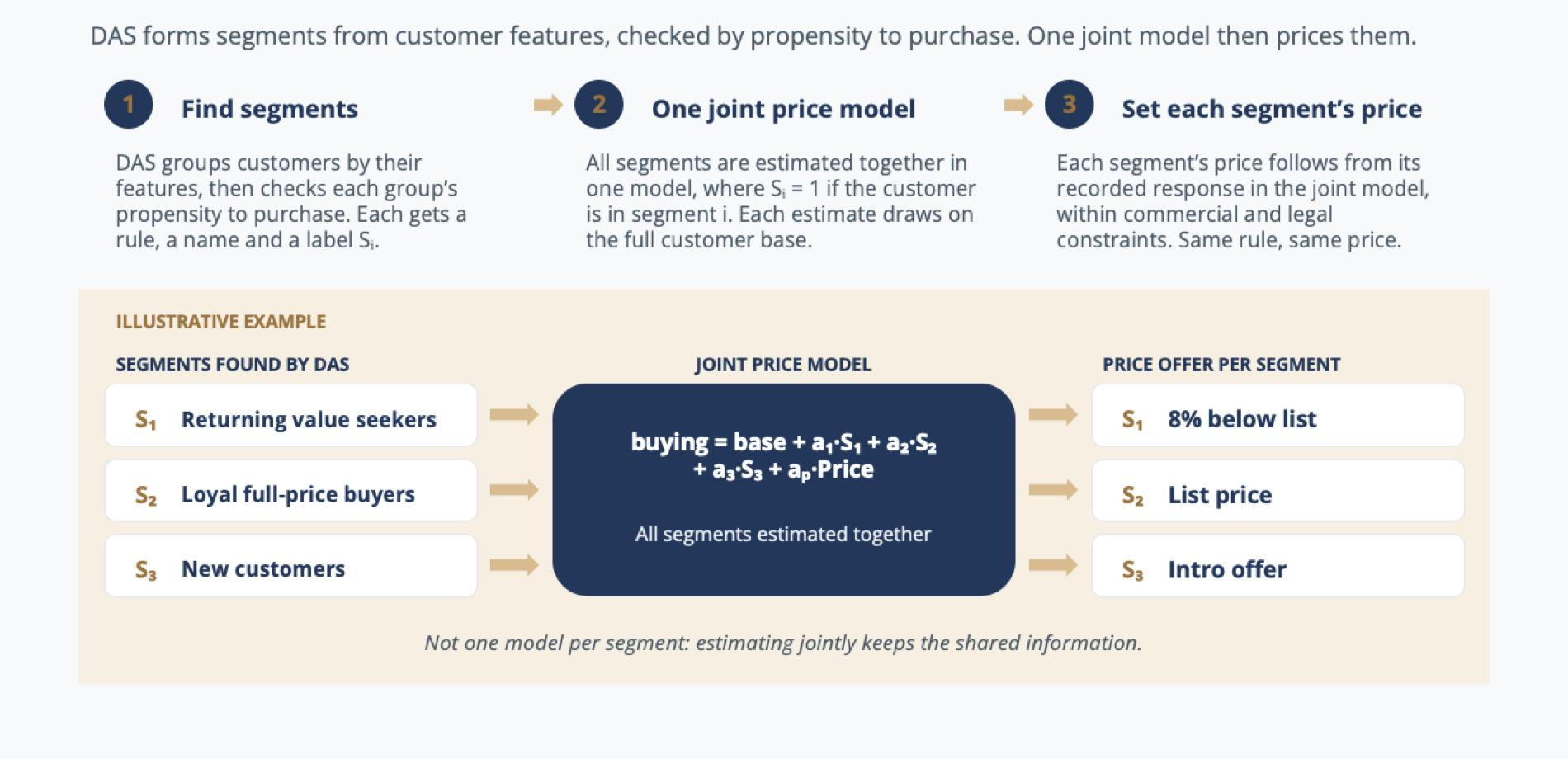
Segments found from customer features, a single joint price model estimating all segments together, and a price offer per segment.
How Many Segments Should We Use?
Broader segments are easier to govern; finer segments keep more pricing precision. The goal is a balance of precision, explanation, governance effort and fairness.
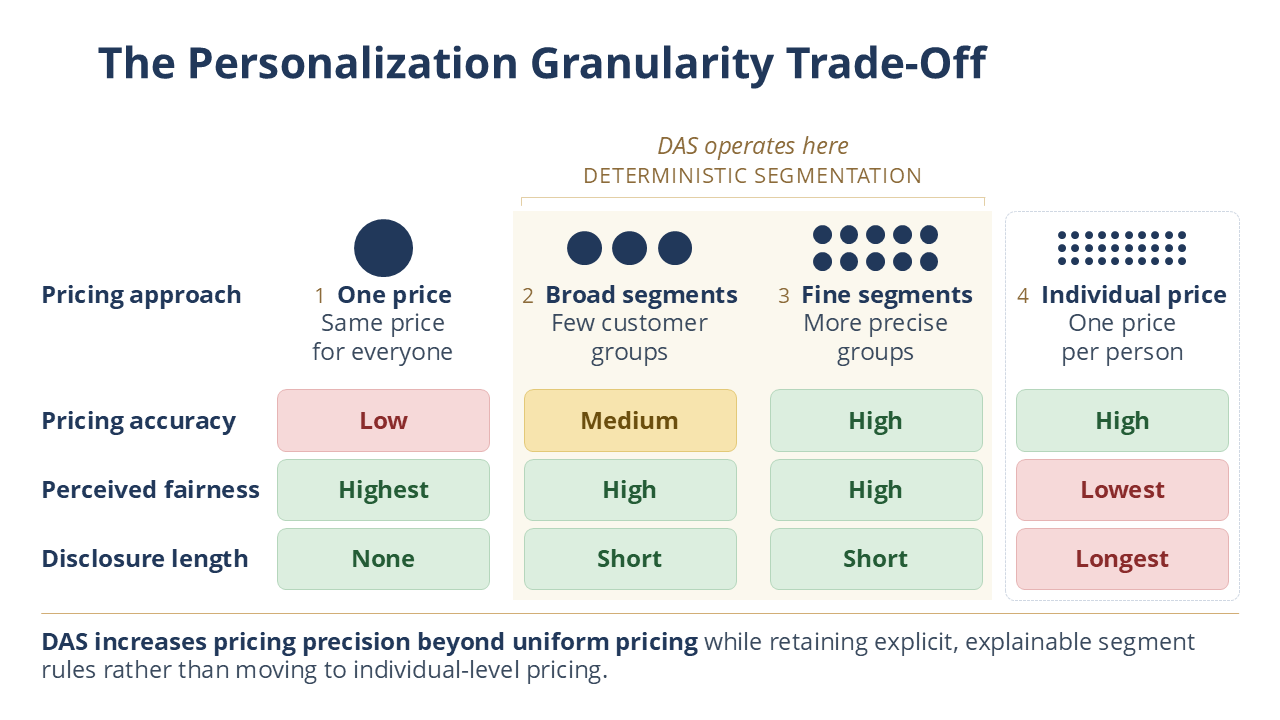
Conceptual comparison; outcomes depend on data, segment design, market context and applicable requirements.
A spectrum from uniform pricing to individual pricing, with deterministic segmentation between them.
Which Laws Apply to Stage 3: Segment?
NY One Fair Price ActNew York
S8623B / A9349B
New York’s One Fair Price Act would ban surveillance pricing, meaning prices set wholly or partly by an algorithm that uses personal data to charge different customers different prices.
PendingDec 31, 2026Connecticut P.A. 26-64Connecticut
SB 4 · Public Act 26-64, § 11
Since October 1, 2026, Connecticut bars retail sellers and third-party delivery services from surveillance pricing: setting a customized price for a consumer based on personal data collected through technology.
In ForceOct 1, 2026Connecticut P.A. 26-130Connecticut
HB 5563 · Public Act 26-130, § 11
From July 1, 2027, a revised Connecticut law bars retail sellers and third-party delivery services from setting a customized price for “a consumer or group of consumers” based on personal data collected through technology.
EnactedJul 1, 2027