Why Can’t Most Pricing Models Explain a Personalized Price?
Personalized pricing laws and proposals ask three things of a business that changes prices or offers based on personal data. It should be able to say that a price was personalized, explain the basis for it and the types of data used, and show how a specific past price was set. The FTC’s August 2026 proposed policy statement, New York’s disclosure law and the bans in Maryland and Connecticut all point in this direction.
Many personalization systems were not built to answer those questions. A machine-learning model typically scores each customer individually across many inputs, and the reason for a particular price is spread across the model rather than recorded when the price is set. Explaining that price, or rebuilding it months later for a regulator or a customer, can be difficult or impossible.
How Does Deterministic Auto-Segmentation Work?
Deterministic Auto-Segmentation replaces individual scores with a small number of defined customer segments. Each segment is described by a short, readable rule — for example, “customers with three or more orders in the past twelve months” — and each segment receives one price or offer.
Every customer falls into exactly one segment, so every price has exactly one reason. When a price is shown, the system records which rule applied, the data the rule used, the resulting treatment and the version of the rule in force. That record is the explanation: it can be shown to a customer, reviewed by compliance staff or used to reproduce the price later.
What Does a Pricing Decision Record Look Like?
In the illustrative travel example below, a customer sees a repeat-traveler fare. Behind it is a single record naming the segment rule, the booking history it relied on, the discount applied and the rule version — enough to explain the fare and to rebuild it later.
One Travel Offer, One Reproducible Record
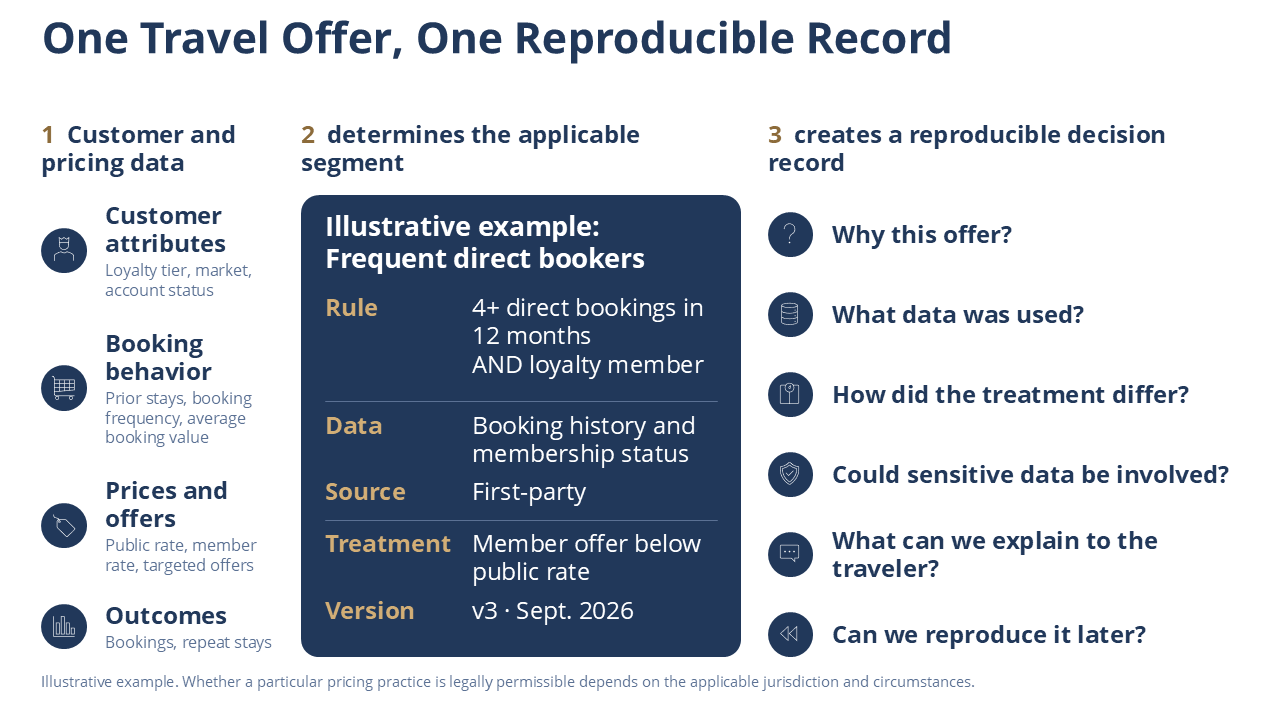
Supplementary illustration of a hypothetical travel example; not a figure from the original whitepaper.
Illustrative example: one travel offer and the decision record behind it.
Which Legal Requirements Does the Framework Address?
| What Regulators Expect | How the Framework Responds |
|---|---|
| Disclose that a price is personalized and its basis | The segment rule is the basis, so the disclosure can be generated directly from it. |
| Identify the types of data used | Each rule names its inputs, so the data behind every price is known in advance. |
| Avoid unexplained or sensitive inferences | Inputs are classified by source and sensitivity before they can be used in a rule. |
| Show how a past price was set | Versioned rules and decision records allow any past price to be reproduced. |
What Are the Five Stages of Implementation?
The framework is implemented in five stages. Each stage has its own page with steps, examples and the laws it addresses.
- 1Classify
Build an inventory of every input that can affect a price and classify each by source, form and sensitivity. This establishes what data can be named in a disclosure.
- 2Audit
Compare current pricing outcomes with a baseline and trace differences to their causes, including inferred or sensitive data. This identifies where existing practices create risk.
- 3Segment
Express personalization as short, non-overlapping rules, each linked to one price or offer. This turns the pricing logic into something that can be read and reviewed.
- 4Disclose
Generate customer-facing explanations from the rule that set the price, at the level of detail each law requires. This keeps disclosures consistent with actual pricing.
- 5Govern
Version every rule, keep decision records and review changes before release. This allows any past price to be reproduced and audited.
Five Stages for Implementing Personalized Pricing
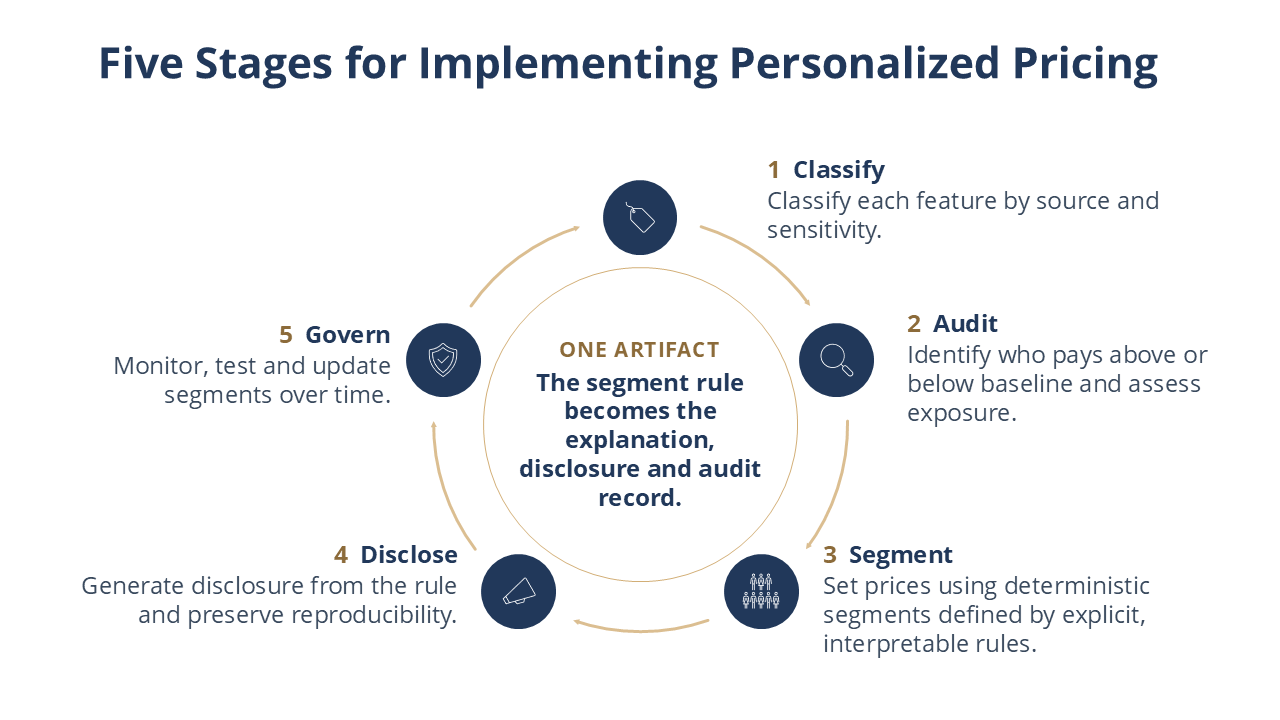
Classify inputs by source and sensitivity, audit current logic and outcomes, segment into readable production rules, disclose explanations derived from those rules, and govern every rule through versioned records.
Do We Have to Replace Our Current Pricing Model?
Existing machine-learning pricing does not need to be replaced at once. One approach is to mimic, then migrate: approximate the current model with readable segment rules, run both in parallel and compare results, then move production pricing to the rules once they perform acceptably.
From Black Box to Deterministic Pricing
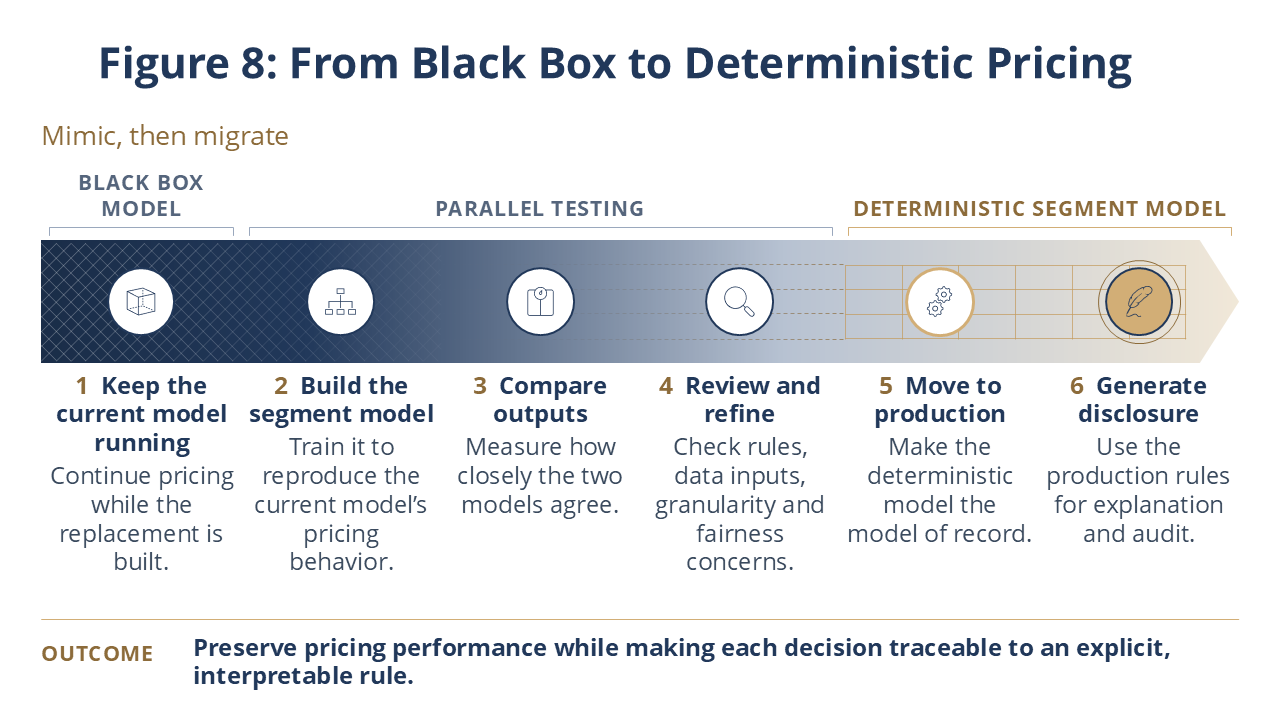
The outcome shown is a design objective of the transition, not a guaranteed performance result.
Mimic, then migrate: the existing black-box model runs alongside a deterministic segment model in parallel testing before any production change.
Does the Framework Make Personalized Pricing Legal?
Deterministic Auto-Segmentation is a pricing architecture, not a legal exemption. It makes pricing visible, reproducible and governable, but it does not decide whether a practice is permitted, whether data was lawfully collected or whether a disclosure satisfies a particular law. Those remain questions for counsel. Some state laws also apply to pricing for groups of consumers, so segment-based pricing can still fall within their scope.