Before anything can be disclosed, a business has to know every piece of data that can change a price. The FTC expects disclosures to name the types of data used, so a disclosure can be no more accurate than this inventory.
Where Does Personalization Happen in Our Pricing?
Personal data can shape the base price, targeted discounts, promotions, loyalty pricing, retention offers, fees, offer ranking and introductory prices. The inventory traces pricing inputs from every screen, email and offer where a price appears.
- Start at the price surface and trace each price to the system that produced it.
- Interview pricing, promotions, CRM, loyalty and e-commerce owners.
- List every feature, including computed scores such as “likely to cancel.”
- Ask each vendor which data it uses.
- Record one line per feature: workflow, source, derivation, owner, and whether it can raise or only lower a price.
How Should Each Pricing Input Be Classified?
| Dimension | Values |
|---|---|
| Source | First-party or third-party |
| Form | Raw data or inferred score |
| Sensitivity | Ordinary, or needs review because it may reveal health, finances, household circumstances, urgency or vulnerability |
| Effect | Can raise a price, can lower a price, or affects eligibility or ranking only |
Why Does Inferred Data Need Extra Review?
A model can infer what it never collected. A retailer reportedly built a pregnancy score from about 25 ordinary products; no field said “pregnant,” but the inference drove the offers. Sensitivity depends on what the data reveals, rather than its field name.
Map Every Input Behind a Personalized Price or Offer
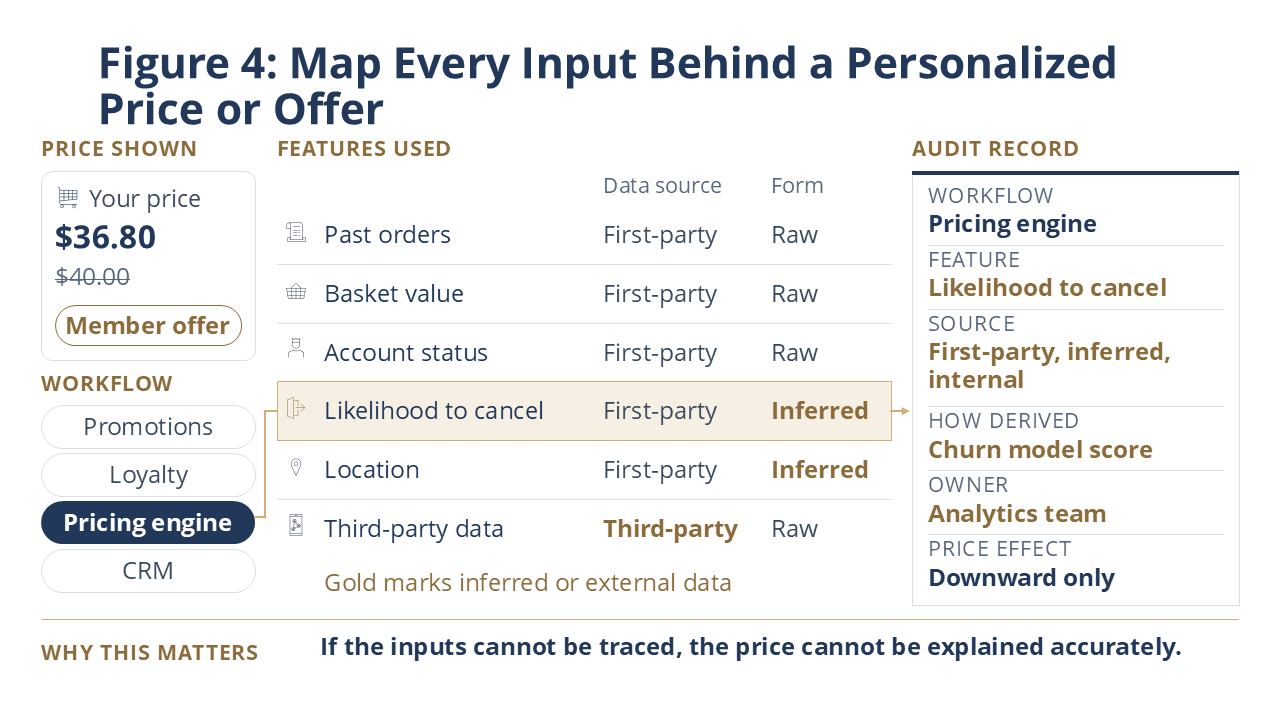
A price shown to a customer, the features used to set it with their data source and form, and the resulting audit record.
Personalization Extends Beyond the Price
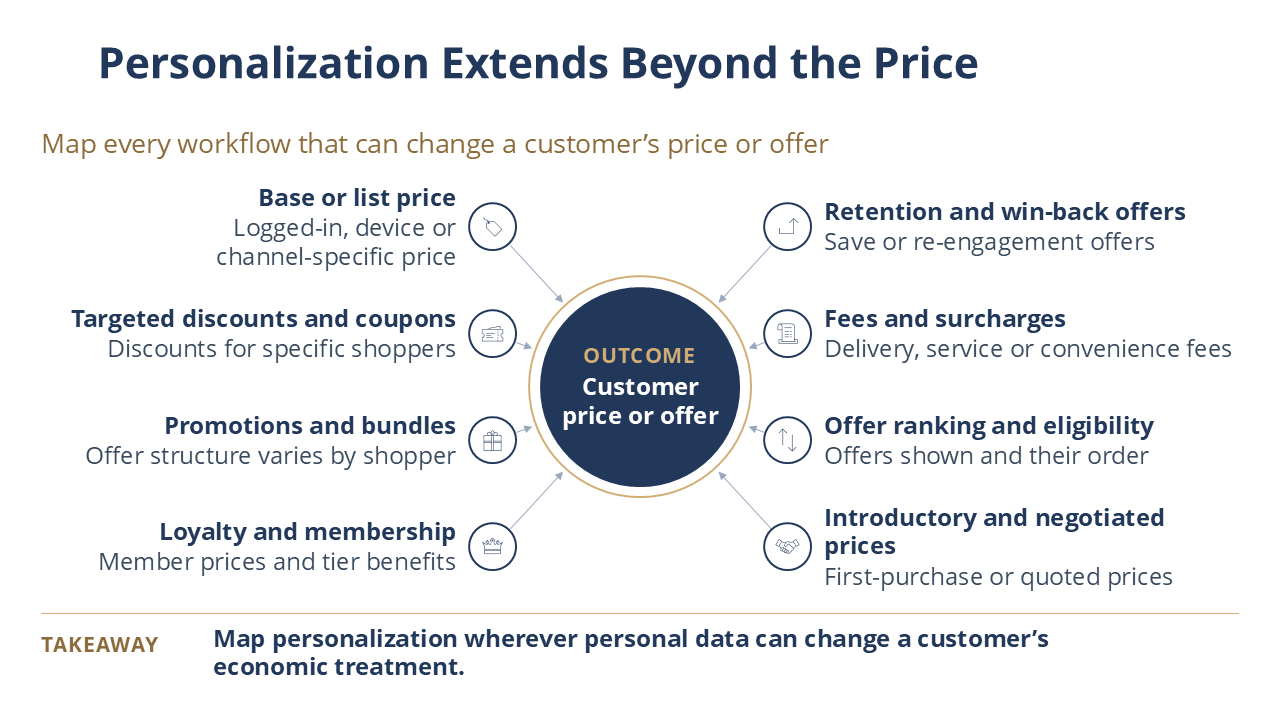
Workflows where personal data can change what a customer pays: base price, discounts, promotions, loyalty pricing, retention offers, fees, offer ranking and introductory prices.
Which Laws Apply to Stage 1: Classify?
FTC Proposed Policy StatementFederal (FTC)
FTC File No. P034101 · FTC Act § 5
The FTC’s proposed policy statement, issued August 19, 2026, says businesses that use personal data to set an individual’s price should clearly disclose that the price is personalized, the basis for it and the types of data used, where consumers reasonably expect a common price.
PendingAug 19, 2026California AB 325California
AB 325 (Cartwright Act amendments)
Since January 1, 2026, California law makes it unlawful to use or distribute a common pricing algorithm that uses competitor data to recommend, align, stabilize or set prices.
In ForceJan 1, 2026